Showing posts with label analysis. Show all posts

Wednesday, March 10, 2021

Aliens Predator CCG: Deductive vs Inductive Planning

Via The Fresh Prince of Beleren
With the full sets of Alien Predator cards recorded into a spreadsheet, they are prepared for data merging and printing. The problem I ran into was deciding which of the ~350 cards in the Premier set of Aliens Predator.
The way that customizable card games are built means theres a lot more options available than you would ever use.
There is not even a maximum number of copies that makes a 'complete' set because Items and Locations have no limit when included in decks. The lack of hard restrictions on what can be included stumped me for a while - I know I have a print limit, and need to filter the card list down to something workable. But with 367 different cards to assemble into 3 distinct decks with their own requirements felt very daunting.

My first plan was to create a set of cards for each faction for the player to build a deck with. I started evaluating which cards to give to each faction, since lots were written to be faction agnostic - even if the card wouldn't be valuable to your faction. I got a fair bit through the Marine faction when I decided to take a different approach:

I simply scrolled through the card records, picked ones that looked important for the faction, and put them into a print queue. It's not perfect or balanced, but the time it would take to get those up to par would be too long. I need playtesting to see if the game is worth keeping as-is, so I need playable decks. And that's exactly what I made!

Tuesday, March 17, 2020

Dune CCG: New Card Faces


The Dune cards hold a ton of information - There are symbols, number attributes, type and timing information, all kinds of stuff. There are about 17 variables contained in each card which makes them tough to design, all that information needs to be organized in a readable and clear manner.

My goal when making these templates was to prioritize learning the game above all else - with complex rules and detailed cards, making the information clear to new players is vital to keep them playing.

The first step was to simply remove the image field. I don't have the resources to create art at this point, so diverting that space to rules text was a given. From there I identified each part of the card that had information important to the player and to give each piece a place on the card.

As an example, some effects refer to one of the five broad card types: Holdings, Plans, Resources, and, Personas, and Events. But the cards in the original game don't list that information - they use a different card frame to indicate card type. I don't think that's enough of an indicator, so I made the card type explicit under the card's Name.

I also added labels for Allegiance, Talent Requirements, Cost, Command and Resources to make those markers more clear. In the base game they are


Personas are the main 'actors' in a game of Dune. They can make battle, begin intrigues, duel other personas, and arbitrate over contracts. They can be improved with Resources like liaisons, vehicles, and weapons.

Plans are temporary special powers that you can play to alter the game. Each Plan's subtype shows where, under which conditions, and what phase it can be played during.


Resources are attached to Personas and Holdings to amplify their abilities. A card's Command is the limit of Resource cards that can be assigned to them.


Holdings are the other key card in Dune. They represent locations or large scale government operations. They often generate resources, and can be upgraded with Resource cards.

Events are special, far-reaching one-time effects that have a larger effect the more turns a player 'charges' them up by playing them face down on the field. When revealed, they trigger their special effects.j

After playing through with a set of these cards, I'm considering how to make room for the art with a redesign. The first alternative I'm thinking is to replace the 'skill box' with Magic: The Gathering Keyword-style text, like Battle 3. Other alternatives include breaking the skill box into 3 separate modules, or to have a full stat line like Warlord CCG.

Wednesday, March 4, 2020

CCG Regeneration: Card Back Designs

I've finished transcribing all the Dune CCG cards and developed templates for new printings:

Image of a card with a blue background, a light blue geometric pattern, with a gold geometric pattern in the foreground. The card is labelled 'House'.

Image of a card with a purple background, a light blue geometric pattern, with a gold geometric pattern in the foreground. The card is labelled 'imperial'.
I wanted the card backs to be very distinct in color, but have a matching design to reinforce the relationship between the House Deck, which represent an individual House's resources, and the Imperial Deck, which represents unique assistance from other forces within the galaxy at large.

I used purple for the Imperial background color to reference the Imperial Deck's higher status, and I used blue to indicate that the House Deck is still of 'nobility' but to a lesser degree.
Both card backs use patterns to add texture to the background color. I chose different patterns to further subtly differentiate the cards from each other.
Both cards use a

"Purple was the color worn by Roman magistrates; it became the imperial color worn by the rulers of the Byzantine Empire and the Holy Roman Empire, and later by Roman Catholic bishops. Similarly in Japan, the color is traditionally associated with the emperor and aristocracy.[7]" - Wikipedia

"Blue has been an important colour in art and decoration since ancient times. The semi-precious stone lapis lazuli was used in ancient Egypt for jewellery and ornament and later, in the Renaissance, to make the pigment ultramarine, the most expensive of all pigments. In the eighth century Chinese artists used cobalt blue to colour fine blue and white porcelain. In the Middle Ages, European artists used it in the windows of cathedrals. Europeans wore clothing coloured with the vegetable dye woad until it was replaced by the finer indigo from America. In the 19th century, synthetic blue dyes and pigments gradually replaced mineral pigments and synthetic dyes. Dark blue became a common colour for military uniforms and later, in the late 20th century, for business suits. Because blue has commonly been associated with harmony, it was chosen as the colour of the flags of the United Nations and the European Union.[2]" - Wikipedia

Tuesday, March 3, 2020

CCG Regeneration 2: Road Map

These are the steps I will follow when investigating old Customizable Card Games for conversion into boxed card games.

Acquire the Game
First step first. Acquiring the game includes finding potential abandoned candidates, collecting rules errata, and obtaining what card information is available in case additional sets are required. Then I order some starter decks or find a Tabletop Simulator module so I can try the game.

Learn the Rules
I read through the rules a couple of times to familiarize myself with the new game. Lots of these games were abandoned because of how complex they are relative to Magic: The Gathering, so I need to be diligent to make sure I understand how it works before bringing it to the table.

Play the Game
I get out the cards and play a few dummy rounds against myself. Even though I have perfect information, this is a very important step in figuring out how the game flows at the table. Any places I run into friction indicate a place in the rules I need to clarify.
This preparation helps me

Record the Cards
I use online scans (or a rare physical collection) to fill a spreadsheet with the card information. Ideally I can get a complete record. Lots of time is spent researching in this stage. I make small changes like incorporating errata and rulings on early cards to reduce the later workload.

Determine if the Game is suitable for conversion
With playtesting, I hope to find if the core game functions without the collectible aspect. I'll work to adapt the game if it is still fun without the excitement and risk of buying randomized packs, the engagement of active support and competitive scene, and the prospect of new sets being released regularly.

Change Rules

With an understanding of the game I can change the rules and cards to better fit the single-box model. Trash tier cards with low utility are re-worked or eliminated, deck construction rules are streamlined, and different formats like Draft and Constructed are formalized. The conversion's structure will take form here - how many different sets of cards, whether expansions in the original game will have to be separated from the 1st edition cards, and so on.

Play Game with new Rules
New rules, new playtests! This step will take the longest. The synergies and interactions in CCGs are very complex and most can't be anticipated outside of playtesting.

Repeat until satisfied, or the game is deemed unsuitable.
And then we're done!

Monday, August 6, 2018

New Project: CCG Regeneration, or reviving out-of-print CCGs by converting them into Single Box, non collectible Card / Board games

Short Shrift:


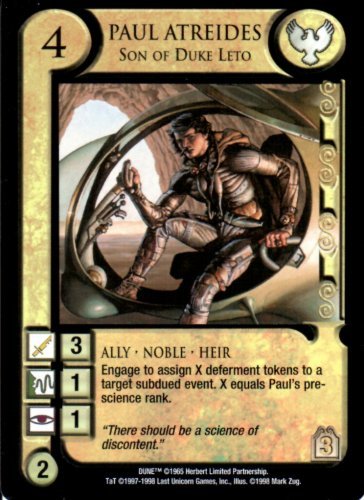
While researching the Dune 4x game concept, I came across information about a discontinued Dune card game. I dug deeper, remembering an advertisement in the InQuest magazine I used to read. It featured Paul Atreides, in an ornithopter cockpit:
On the surface, the game appeared to be a clone the popular card game Magic: The Gathering, which had popularized the selling of randomized packs of cards to be used on a competitive game. But the details distinguished Dune from it's antecedent.
The rules of Dune are much more specific and layered than in Magic - as an example, each card tells you the exact phase and conditions where you can play it, even down to the step of the turn and how long the card's effect will last. 
The game is built to support more than 2 players, and has a two-tiered win condition of gathering enough spice and enough political favor - conquest and destruction are a means to an end, but not an end of themselves.

This started me on a journey of discovery and seeded the idea of converting old, out of print Customisable Card Games (CCG) into single box, complete card games. 

Buried Games:
Dune CCG
Aliens Predator CCG
Terminator CCG
Star Trek 1st / 2nd Edition CCG

Friday, March 17, 2017

Deck Building Adventure Game, Part 3: First steps

So now that I've got my goals ready (Challenge, Fellowship, and Expression) it's time to build what the game is.

Italic is a game mechanic term
Bold is a thematic term


Who:
The game is built for Player(s). The target group is teens through adults because of the complexity of the interactions. The themes of the game would suit players that enjoy cooperative games with strong thematics, a moderate amount of chance, and many options. The game is not designed for those who desire strictly low chance, a competitive atmosphere, or an abstract setting.

What: (The big one)
I want a game where the player acts to [ overcome challenges using the resources available to them ]. That's the core gameplay loop - most of the play in the game will be this.

A supporting loop is that [ overcoming challenges provides additional resources ] and that [ failing to overcome challenges provides penalties ].

[ Failing too many or key challenges will result in a Lose condition ].

The challenges for a match are selected from a large pool.
Challenges are divided into Sets that share a Theme or Setting.

Where:
Physical copies of the game are built to be played on a table with ample space. Digital copies would be suitable for Windows, Android, and iOS.

When:
1-2 years of hobby time to generate the game, test it, and make prototypes

Why:
To have a cooperative game that combines the play of deck builders with the progression and persistence of adventure games

Tuesday, March 14, 2017

New Project! Deck Building Adventure Game, Part 1

This post is about another project I'm starting. The goal is to combine the play mechanics of a deck building game with the character progression and exploration mechanics from an adventure or dungeon crawler game, with a narrative generating bent.

I've enjoyed deck building games since I first tried Dominion a few years ago. I like that deck builders combine the tactics of playing Collectible Card Games (Magic the Gathering, YuGiOh, Shadowverse) and the strategy of assembling a deck beforehand.

I also enjoyed the stories that are generated by playing through strongly themed deck building games like Legendary Encounters: Alien, and other games like Imperial Assault and Hand of Fate.

I want to fuse the two in order to create a hybrid experience.

Monday, March 13, 2017

Tabletop Spaceship Wargame Design Part 10, Researching Firestorm Armada v2

Firestorm Armada is a fleet system that is as complex as Battlefleet Gothic but using different mechanics to accomplish dynamics.

Weapons roll pools of six sided dice to determine how effective the shots are at damaging the target.

Weapons have a profile that describes how many dice they roll at each range. These dice are rolled and compared to
Dice that turn up as a 6 'explode' and add another die to the pool.  Instead of each success dealing a point of damage, the total number of successes are compared to the target's armor. If successes >= Armor, the ship takes a hit.

After testing out the game I found the exploding dice to be untenable. It resulted in lots of unfun situations, either impossible comebacks or annihilating any chance of a comeback.
The armor system also generates situations where a ship's turn results in nothing if they don't score enough hits. For me that doesn't fly. My target is a few ships, so each activation should be impactful. With the armor system, perfect tactics can be denied an effect due heavily to dice rolls.

Tuesday, March 8, 2016

Tabletop Spaceship Wargame Part 10, Researching A Call To Arms

Analysis of the Call to Arms system

Core Gameplay
Call to Arms uses a base movement system, attack system, and special actions ships can use to alter their performance.

Players roll for initiative every round.
Loser activates one of their ships first, then players take turns activating ships until every unit has been moved.

In Babylon 5, units must move half their Move rating forward every activation. After that they may make their first turn according to their turn rating. If they have multiple turns, they must move 2" after the previous turn before turning again.

In Star Trek all units can move up to 12", they may stay stationary or go in reverse. A ship's Movement Rating is how many inches forward the ship must travel before turning. Therefore, a ship with a turn rating of 6 can turn twice if it moves 12" - the first turn at 6", and the second at 12".

After moving, the activated ship chooses which special action to make and performs the necessary test. Special Actions alter how ships operate or provide additional abilities. Each advantage comes with a trade off or restriction and some have a chance of failure. If a special action requires a test and is failed, the ship acts as normal and it's special action has been wasted.

Once all capital ships have been moved, auxiliary craft are moved.

========================================================================

Attack Phase
Players may measure distance at any time.

The player that won initiative picks a capital ship unit and activates it. They then choose which weapons will attack which targets, and then resolve these weapon attacks one at a time. Weapons have a maximum range, a fire arc they can shoot out of, the number of dice they roll to attack, and special properties that alter the weapon's effect on the base mechanic.

The attack dice are rolled and successes score damage against the target.

In Babylon 5, the target has a hull rating that determines what rolls hurt the target.
In Star Trek, all targets are hit on a 4+ by default. Range, ship and weapon traits can alter these results.

The number of hits that surpass the defenses then roll again to determine their effect. 1 deals no damage, 2-5 deals 1 damage, and 6 deals 1 damage and causes a critical effect. Weapon traits can alter these results.

Each critical result rolls a die on the critical chart to determine the system hit.

In Babylon 5, any crit could generate any severity of result.
In Star Trek, each crit to a location inflicts an increasingly severe effect.

Damage is recorded. Below a certain threshold, ships become Crippled. This severely weakens the ship and limits it's capabilities.

After a ship resolves all of it's attacks, the other player activates a capital ship and play repeats until all capital ships have fired.

Once all capital ships have attacked, auxiliary craft have their chance to attack. In Babylon 5, If they are contacting other auxiliary craft, they attack using Dogfight rules.

========================================================================

The rules play well after the initial learning curve. The use of dice pools to resolve weapon attacks allows reliable estimation of a weapon's expected performance. Ships are capable and have statistics that make fleet construction interesting. Their interactions fit the theme of each fiction they seek to model and resolve rapidly.

The exception based ruleset is difficult to learn at first due to the variability of conditions and sequencing. The lack of reference components makes checking the rules taxing. The high amount of ship hit points is a chore to track without component assistance. Critical Hits take a lot of rolls to determine and referencing the chart and effects takes time. Tracking the effects of Critical hits across a battle is difficult without component assistance. The rules are written in an unclear manner.

The game has had balance issues since publication for Babylon 5 more than four editions ago. Lots of testing will be required to ensure as much fairness as possible when using these mechanics.

Tuesday, March 1, 2016

Tabletop Spaceship Wargame Part 9, Researching Star Wars Armada

Before I continue with developing my game I'm going to examine several other entries in the genre. I'll summarize the game system and then interpret my findings for my game.\


This entry will concern Star Wars: Armada (SWA) by Fantasy Flight Games.

SWA is a science fiction miniature wargame set in the Star Wars universe. Players build fleets and selects upgrade and configuration cards to an agreed point value. Once your fleet is constructed you select 3 objectives from a set of 12 that will suit your fleet. The player with the least points in their fleet chooses who is first player. First player looks at the objectives of the Second Player and picks one. That determines the special conditions of the scenario.

The map is 6' x 3' with non-grid movement.
Ships that leave the map are destroyed.
Each game lasts 6 rounds.

Ships have attacks in each of four firing arcs. Different ships have different sized arcs; these differences are shown on each ship's base. Each arc shows it's attack rating which determines how many dice of each type that arc uses when attacking.

There are three types of dice in SWA that determine the range band they can be used at and the relative distribution of results on them. Red dice are long range, blue dice are medium range and have no blank faces, and black dice are short ranged and have more Critical ratings. Squadrons can only fire any dice up to Distance 1. Exception rules can allow dice to be fired outside of their normal range set.

Ships can make 2 attacks per turn as long as they are out of two different arcs. Attacks are resolved by selecting an attacker, selecting a target, checking fire arc and range, check for obstruction, then rolling dice. You total the damage and record any critical results, the opponent decides whether to use any Defense tokens they have to reduce the impact of the attack and then damage is resolved on the target.

When damage pierces the shields and a critical result is available a damage card is flipped over and inflicts a negative effect on the target.

Movement is handled through several components interacting. A ship has a speed value that determines how often and how quickly it can turn. Each ship card has a diagram showing how many turns at which distance the ship can make. To move the ship, you grab the movement tool component and click it into a shape that matches the legal moves shown on the ship card. You lock the ruler into the base and then move the ship to the distance segment that matches the ship's speed.

Ships perform special actions by selecting from four choices ahead of their turn. Larger ships need to pick these actions in advance. These special actions are how ships change their speed, control fighters, repair, and concentrate fire.

Squadrons can either move or fire after all capital ships have moved and fired. With a capital ship special action and proximity they can move and attack, before the other ships. Squadrons have hit points and attack ratings against capital ships and fighters. They have no facing and no heading restrictions. When capital ships attack fighters, they roll dice against each squadron within a firing arc with their anti-squadron value.

--------------------------------------------------------------------------------------------------------------------------

I had a hard time playing this game. The rules are written in an incoherent style and out of order so I ran the game incorrectly several times. From my experience the game is functional but far from what I want, and it doesn't feel like Star Wars.

Let's go into each element.

Components
This game relies heavily on proprietary components to be playable. From the range and distance ruler, to the maneuver tool, to the damage deck, to the custom 8 sided dice used to attack, to the upgrade cards, to the ship cards, to the base plates, and so on and so on. From a utility perspective the reliance on such components makes the game less accessible. If a component breaks or becomes lost, replacing it is more difficult and costly than general implements.

There is also the issue of how effective the components are:


Damage Deck: The use of this to generate critical hits is flawed. Each card removed from the deck takes some number of different critical results out of the potential pool, altering the probability of receiving any given critical result. For this to operate damage cards need to be stacked near the stricken ship's card which can cause organizational problems with the higher hull point ships. Either the cards are stacked and it's difficult to tell how damaged the ship is, or they are spread out and take up a large amount of table space to communicate a small amount of information.

Solutions:
Critical results should be determined by a random result whose probabilities don't change based on how much damage has been dealt in the game. Rolling dice and comparing the result to a chart is an example. Having a marker for each critical in the shape of a card is acceptable but the method to generate those results is not.


Range Ruler
This component performs approximately as expected. A tape measure is better for maneuvering Squadrons since the length of the ruler can get in the way and move ships accidentally. The cardboard can bend as well as peel, so quality is an issue.

Solution:
Distances measured in inches / cm so that any measuring tool can be used.


Movement Tool
This component does not achieve it's basic function of precision movement within the rules. The plastic it is made of is so flexible that a player can shift the position of their end point. The use of the tool also requires three separate components to function properly - the speed dial, the ship card's maneuver chart, and the slotted base to lock the tool into. The length of the tool, like the Range Ruler, is awkward and can accidentally shift ships.

Solution:
Have a standard movement measure in inches / cm. Have each ship card show the amount it must move forward before it can turn. Speed determines the full distance the ship must move.


Squadron Bases
Squadrons are mounted on round bases and have an activation toggle and rotating HP dial. The stiffness of the components makes it difficult to adjust Squadron HP without shifting their base. The initiative toggles slide out the side of the base which makes placing the fighters close together impossible.

Solution:
Represent squadron HP with a die. Represent squadron activation with a colored token.


Mechanics
========================================================================
The Command dials system is interesting and I like the hidden simultaneous orders. However I find it doesn't add much to play. It allows mistakes to be punished easily for slower ships and has minimal penalty and maximum benefit for small ships. The timing and use of tokens complicates play while adding small or very conditional benefit. The structure of the rules makes the Maneuver command vital, while concentrate fire adds a small bonus. Squadron Command is one of the only ways to use Squadrons effectively and it still has too many restrictions to be fully effective.

Solution:
Replace Commands with system akin to Special Actions that are a tradeoff with a chance of failure or penalty. The raw capability of ships should not be inhibited to make room for this system.


Squadrons
Squadrons are not effective enough. Overall they rarely get used outside of lists built to support them completely, or with special edge cases like 8 A-Wings. They cost points to field and if you lose all of your capital ships you lose the scenario, so each fighter is taking away from that threshold. They tend to have single die attacks against capital ships and most cannot deal critical effects. Some of these factors are mitigated with the Squadron command and others with hero squadrons, but squadrons should be an effective auxiliary to the fleet without intense handicap, specialization, or extreme edge cases.

Solution:
Each capital ship comes with a set amount of Squadrons included in it's point cost.
- or -
completely rework squadrons to be either less of a factor, or more of a factor in gameplay.

Upgrades
Upgrades in this game come in several types. One squadron of each type can be upgraded to a unique 'hero' squadron with an ability and modified statistics.
Capital Ships can be upgraded with upgrades and unique titles. Unique titles are upgrades that alter statistics or provide abilities to a ship of a specific type. Each Unique Title can only be used once in a fleet, and can only be applied to the Title's key ship.
Each capital ship has a list of upgrade 'slots'. Each slot lets that ship equip a single upgrade of that type for the point cost listed on the card.

The problem: An upgrade costs the same regardless of what ship takes it. That does not take into account the difference between all of the ships that can equip an upgrade. It undermines the whole point of a point based fleet purchasing system. The unique upgrades do not scale with fleet size.
Ships are incapable without upgrades - they are designed to only be fielded with equipment to be effective.

Solution:
Each ship pays a price for a given upgrade based on it's effectiveness on *that ship*. Cards can be used to record the upgrade powers.

Conclusion:
There isn't much I can take from this game due to how ineffective the mechanics are in terms of accessibility and balance complexity.