Showing posts with label custom. Show all posts

Wednesday, March 10, 2021

Aliens Predator CCG: Deductive vs Inductive Planning

Via The Fresh Prince of Beleren
With the full sets of Alien Predator cards recorded into a spreadsheet, they are prepared for data merging and printing. The problem I ran into was deciding which of the ~350 cards in the Premier set of Aliens Predator.
The way that customizable card games are built means theres a lot more options available than you would ever use.
There is not even a maximum number of copies that makes a 'complete' set because Items and Locations have no limit when included in decks. The lack of hard restrictions on what can be included stumped me for a while - I know I have a print limit, and need to filter the card list down to something workable. But with 367 different cards to assemble into 3 distinct decks with their own requirements felt very daunting.

My first plan was to create a set of cards for each faction for the player to build a deck with. I started evaluating which cards to give to each faction, since lots were written to be faction agnostic - even if the card wouldn't be valuable to your faction. I got a fair bit through the Marine faction when I decided to take a different approach:

I simply scrolled through the card records, picked ones that looked important for the faction, and put them into a print queue. It's not perfect or balanced, but the time it would take to get those up to par would be too long. I need playtesting to see if the game is worth keeping as-is, so I need playable decks. And that's exactly what I made!

Tuesday, March 17, 2020

Dune CCG: New Card Faces


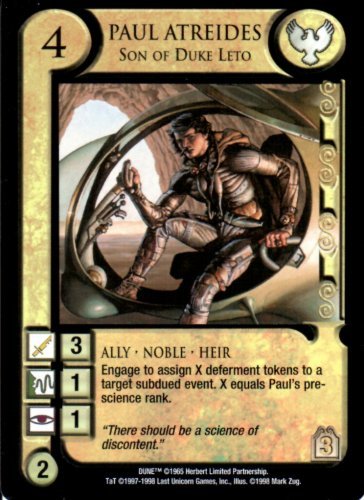
The Dune cards hold a ton of information - There are symbols, number attributes, type and timing information, all kinds of stuff. There are about 17 variables contained in each card which makes them tough to design, all that information needs to be organized in a readable and clear manner.

My goal when making these templates was to prioritize learning the game above all else - with complex rules and detailed cards, making the information clear to new players is vital to keep them playing.

The first step was to simply remove the image field. I don't have the resources to create art at this point, so diverting that space to rules text was a given. From there I identified each part of the card that had information important to the player and to give each piece a place on the card.

As an example, some effects refer to one of the five broad card types: Holdings, Plans, Resources, and, Personas, and Events. But the cards in the original game don't list that information - they use a different card frame to indicate card type. I don't think that's enough of an indicator, so I made the card type explicit under the card's Name.

I also added labels for Allegiance, Talent Requirements, Cost, Command and Resources to make those markers more clear. In the base game they are


Personas are the main 'actors' in a game of Dune. They can make battle, begin intrigues, duel other personas, and arbitrate over contracts. They can be improved with Resources like liaisons, vehicles, and weapons.

Plans are temporary special powers that you can play to alter the game. Each Plan's subtype shows where, under which conditions, and what phase it can be played during.


Resources are attached to Personas and Holdings to amplify their abilities. A card's Command is the limit of Resource cards that can be assigned to them.


Holdings are the other key card in Dune. They represent locations or large scale government operations. They often generate resources, and can be upgraded with Resource cards.

Events are special, far-reaching one-time effects that have a larger effect the more turns a player 'charges' them up by playing them face down on the field. When revealed, they trigger their special effects.j

After playing through with a set of these cards, I'm considering how to make room for the art with a redesign. The first alternative I'm thinking is to replace the 'skill box' with Magic: The Gathering Keyword-style text, like Battle 3. Other alternatives include breaking the skill box into 3 separate modules, or to have a full stat line like Warlord CCG.

Wednesday, March 4, 2020

CCG Regeneration: Card Back Designs

I've finished transcribing all the Dune CCG cards and developed templates for new printings:

Image of a card with a blue background, a light blue geometric pattern, with a gold geometric pattern in the foreground. The card is labelled 'House'.

Image of a card with a purple background, a light blue geometric pattern, with a gold geometric pattern in the foreground. The card is labelled 'imperial'.
I wanted the card backs to be very distinct in color, but have a matching design to reinforce the relationship between the House Deck, which represent an individual House's resources, and the Imperial Deck, which represents unique assistance from other forces within the galaxy at large.

I used purple for the Imperial background color to reference the Imperial Deck's higher status, and I used blue to indicate that the House Deck is still of 'nobility' but to a lesser degree.
Both card backs use patterns to add texture to the background color. I chose different patterns to further subtly differentiate the cards from each other.
Both cards use a

"Purple was the color worn by Roman magistrates; it became the imperial color worn by the rulers of the Byzantine Empire and the Holy Roman Empire, and later by Roman Catholic bishops. Similarly in Japan, the color is traditionally associated with the emperor and aristocracy.[7]" - Wikipedia

"Blue has been an important colour in art and decoration since ancient times. The semi-precious stone lapis lazuli was used in ancient Egypt for jewellery and ornament and later, in the Renaissance, to make the pigment ultramarine, the most expensive of all pigments. In the eighth century Chinese artists used cobalt blue to colour fine blue and white porcelain. In the Middle Ages, European artists used it in the windows of cathedrals. Europeans wore clothing coloured with the vegetable dye woad until it was replaced by the finer indigo from America. In the 19th century, synthetic blue dyes and pigments gradually replaced mineral pigments and synthetic dyes. Dark blue became a common colour for military uniforms and later, in the late 20th century, for business suits. Because blue has commonly been associated with harmony, it was chosen as the colour of the flags of the United Nations and the European Union.[2]" - Wikipedia

Tuesday, March 3, 2020

CCG Regeneration 2: Road Map

These are the steps I will follow when investigating old Customizable Card Games for conversion into boxed card games.

Acquire the Game
First step first. Acquiring the game includes finding potential abandoned candidates, collecting rules errata, and obtaining what card information is available in case additional sets are required. Then I order some starter decks or find a Tabletop Simulator module so I can try the game.

Learn the Rules
I read through the rules a couple of times to familiarize myself with the new game. Lots of these games were abandoned because of how complex they are relative to Magic: The Gathering, so I need to be diligent to make sure I understand how it works before bringing it to the table.

Play the Game
I get out the cards and play a few dummy rounds against myself. Even though I have perfect information, this is a very important step in figuring out how the game flows at the table. Any places I run into friction indicate a place in the rules I need to clarify.
This preparation helps me

Record the Cards
I use online scans (or a rare physical collection) to fill a spreadsheet with the card information. Ideally I can get a complete record. Lots of time is spent researching in this stage. I make small changes like incorporating errata and rulings on early cards to reduce the later workload.

Determine if the Game is suitable for conversion
With playtesting, I hope to find if the core game functions without the collectible aspect. I'll work to adapt the game if it is still fun without the excitement and risk of buying randomized packs, the engagement of active support and competitive scene, and the prospect of new sets being released regularly.

Change Rules

With an understanding of the game I can change the rules and cards to better fit the single-box model. Trash tier cards with low utility are re-worked or eliminated, deck construction rules are streamlined, and different formats like Draft and Constructed are formalized. The conversion's structure will take form here - how many different sets of cards, whether expansions in the original game will have to be separated from the 1st edition cards, and so on.

Play Game with new Rules
New rules, new playtests! This step will take the longest. The synergies and interactions in CCGs are very complex and most can't be anticipated outside of playtesting.

Repeat until satisfied, or the game is deemed unsuitable.
And then we're done!

Monday, August 6, 2018

New Project: CCG Regeneration, or reviving out-of-print CCGs by converting them into Single Box, non collectible Card / Board games

Short Shrift:


While researching the Dune 4x game concept, I came across information about a discontinued Dune card game. I dug deeper, remembering an advertisement in the InQuest magazine I used to read. It featured Paul Atreides, in an ornithopter cockpit:
On the surface, the game appeared to be a clone the popular card game Magic: The Gathering, which had popularized the selling of randomized packs of cards to be used on a competitive game. But the details distinguished Dune from it's antecedent.
The rules of Dune are much more specific and layered than in Magic - as an example, each card tells you the exact phase and conditions where you can play it, even down to the step of the turn and how long the card's effect will last. 
The game is built to support more than 2 players, and has a two-tiered win condition of gathering enough spice and enough political favor - conquest and destruction are a means to an end, but not an end of themselves.

This started me on a journey of discovery and seeded the idea of converting old, out of print Customisable Card Games (CCG) into single box, complete card games. 

Buried Games:
Dune CCG
Aliens Predator CCG
Terminator CCG
Star Trek 1st / 2nd Edition CCG

Monday, March 13, 2017

Tabletop Spaceship Wargame Design Part 10, Researching Firestorm Armada v2

Firestorm Armada is a fleet system that is as complex as Battlefleet Gothic but using different mechanics to accomplish dynamics.

Weapons roll pools of six sided dice to determine how effective the shots are at damaging the target.

Weapons have a profile that describes how many dice they roll at each range. These dice are rolled and compared to
Dice that turn up as a 6 'explode' and add another die to the pool.  Instead of each success dealing a point of damage, the total number of successes are compared to the target's armor. If successes >= Armor, the ship takes a hit.

After testing out the game I found the exploding dice to be untenable. It resulted in lots of unfun situations, either impossible comebacks or annihilating any chance of a comeback.
The armor system also generates situations where a ship's turn results in nothing if they don't score enough hits. For me that doesn't fly. My target is a few ships, so each activation should be impactful. With the armor system, perfect tactics can be denied an effect due heavily to dice rolls.

Wednesday, February 10, 2016

Tabletop Spaceship Game Part 3, Foundation

The Atomic approach
Utilizing a reductive method to start from the smallest elements of a game, and after identifying and understanding each, combining them into stable molecules and compounds to support the original intent.


This lecture series on Youtube proved a good place to start for me to understand wargames from a longer and wider perspective than my own. I'm incorporating pieces of these lectures in addition to Mark LeBlanc's work to create a solid foundation that I can reference when creating mechanics further in the design process.

I will utilize material covered in this video:

Introduction, Features of All Games


Representation
What you see in front of you when you look at the game.
The game is represented by the various miniatures or tokens arrayed on a [gridded/open ] play map with reference cards for each faction set to the side. Several colors of dice will be available and a track marking victory progress for each player. Templates and measuring aids will be available as well, with a rules reference sheet and full rulebook out of the play area.


Mechanics
Mechanics are things you assemble to get a game - mechanisms that execute to make the game function.
Mechanisms slated in the game at this point are to remain mostly undefined to fit my atomic approach.

Confirmed mechanics:
Player Turns
Dice Rolling
Modular Board
Variable Player Powers
Capture / Eliminate
Movement
Resource Management
Risk & Reward
Game Modes
Piece Elimination
Victory Points
Loss Avoidance

Possible mechanics:
Reference Cards
Force Construction
Factions|Open Purchase
Catch Up
Secret Unit Deployment
Time Track
Action Point system (Star Fleet Battles, Federation Commander)
Rock Paper Scissors
2+ players
Team play
Player Elimination
Cooperative Scenarios
Wagering resources / Press your Luck
Campaign Play
Route Building
Card Driven Battle / Campaign
Deck / Pool Building
Point to Point movement
Simultaneous Action Selection
Action Programming / Pencil and Paper, recording orders
Variable Unit Command / 'Chit-pull system'
Grid Movement
Memory
Area Control / Influence
Pick up and Deliver

Style
emphasis of a specific mechanic, what mechanic the game relies on.
This will have to be rather light at this point, because so little of the game is established picking mechanics to emphasize is premature.

Theme
What is the game about
The game is about fleets of spaceships fighting.

Components
What falls out of the box when overturned
Play Surface
Dice
Tokens
Chit Counters
Reference Cards, Sheets, Rules
Rulebook
Miniatures
Templates
Ruler
Terrain tiles

'Shape'
Term from Japanese game Go, Thin and elegant or Thick and clumsy
How much space the game uses in a player's life
The target for this game is to have a very thin presence for play and setup, and ideally a thick space in overall time playing.

Voice
I / We / First Person
You / You / Second Person
*He/She / They / 3rd Person*
The player's actions reflect the decisions and participation of hundreds or even thousands of imaginary officers and crew.

Content
Subject of the game
What are the resources?
This overlaps quite a bit with Theme, and so far isn't well defined with the current rules (or lack thereof) at this time. Content is what distinguishes this game from others like it.

As the game goes through iterative design, I'm going to revisit these elements and fill them in.

New project! Tabletop Starship Wargame, Part 1

Hey there. After playing Star Wars Armada and X Wing miniatures, it stoked the fire of an old desire to create my own table top wargame system with spaceships.


Each game I've played in that genre has left me with some issue or another, and I've experienced enough different systems that I've got a good idea of what I want in and what I want left out.


I'll start with the elements from the games I have experienced that ended up being sticking points that have lead to me creating my own system.


I have played Call to Arms: Babylon 5, Call to Arms: Star Fleet, Battlefleet Gothic, Star Wars: Armada, Star Wars: X Wing, and am familiar with Halo: Fleet Battles, Firestorm: Armada, Federation Commander and Star Fleet Battles.


The goals for this game system are as follows:
1. It should play fast.
2. It is Capital Ship Fleet scale
3. Fighter Craft play a role


Ideally, here are some additional preferences:
A. Construction rules will be provided so players can create profiles for their own imagined ships
B. The ruleset should be flexible enough to represent a wide variety of ships.
C. The game should scale up in a reasonable fashion.

With these thoughts in mind, we begin.