Showing posts with label tutorial. Show all posts

Wednesday, March 10, 2021

Aliens Predator CCG: Deductive vs Inductive Planning

Via The Fresh Prince of Beleren
With the full sets of Alien Predator cards recorded into a spreadsheet, they are prepared for data merging and printing. The problem I ran into was deciding which of the ~350 cards in the Premier set of Aliens Predator.
The way that customizable card games are built means theres a lot more options available than you would ever use.
There is not even a maximum number of copies that makes a 'complete' set because Items and Locations have no limit when included in decks. The lack of hard restrictions on what can be included stumped me for a while - I know I have a print limit, and need to filter the card list down to something workable. But with 367 different cards to assemble into 3 distinct decks with their own requirements felt very daunting.

My first plan was to create a set of cards for each faction for the player to build a deck with. I started evaluating which cards to give to each faction, since lots were written to be faction agnostic - even if the card wouldn't be valuable to your faction. I got a fair bit through the Marine faction when I decided to take a different approach:

I simply scrolled through the card records, picked ones that looked important for the faction, and put them into a print queue. It's not perfect or balanced, but the time it would take to get those up to par would be too long. I need playtesting to see if the game is worth keeping as-is, so I need playable decks. And that's exactly what I made!

Wednesday, March 18, 2020

Aliens Predator CCG: Card Design Part 1

Aliens Predator Card Designs
A problem with all the cards is the font used in the name. It has readability issues and could be improved. Second, the Resources and Restrictions listed along the left side of the cards are printed vertically. That's hard to read without turning the cards or craning your head, and this text is often required to tell if you can play a card or not.

Locations form the 'map' where the game takes place. Characters move between adjacent locations, and can search them for equipment and supporting characters. I like the graphic card frame and the prominence of the image. 

Main Characters are under the direct control of the players. They move, attack, and search for supporting characters and items. These frames look interesting, but the flavor text overlaps some of the graphic elements making it harder to read.

Supporting Characters are found by main characters and are used by the different factions to win the game. The contrast on the card is nice - they look really plain, and wildly different than the other character cards for easy distinction.

Events are played for temporary buffs or penalties. I like the design but the texture under the effect text makes it harder to read than necessary.

Items are used by the Humans and the Predators. The Human Item frame is very solid. I like the graphics and the texture doesn't interfere with the Effect Text and the Flavor Text. The Predator frame has wasted Effect Text space, and the texture underlays the Name and Flavor Text entirely.

These cards were redesigned with the release of the Resurrection expansion, and to match the Terminator CCG which used the same rule system.

Tuesday, March 3, 2020

CCG Regeneration 2: Road Map

These are the steps I will follow when investigating old Customizable Card Games for conversion into boxed card games.

Acquire the Game
First step first. Acquiring the game includes finding potential abandoned candidates, collecting rules errata, and obtaining what card information is available in case additional sets are required. Then I order some starter decks or find a Tabletop Simulator module so I can try the game.

Learn the Rules
I read through the rules a couple of times to familiarize myself with the new game. Lots of these games were abandoned because of how complex they are relative to Magic: The Gathering, so I need to be diligent to make sure I understand how it works before bringing it to the table.

Play the Game
I get out the cards and play a few dummy rounds against myself. Even though I have perfect information, this is a very important step in figuring out how the game flows at the table. Any places I run into friction indicate a place in the rules I need to clarify.
This preparation helps me

Record the Cards
I use online scans (or a rare physical collection) to fill a spreadsheet with the card information. Ideally I can get a complete record. Lots of time is spent researching in this stage. I make small changes like incorporating errata and rulings on early cards to reduce the later workload.

Determine if the Game is suitable for conversion
With playtesting, I hope to find if the core game functions without the collectible aspect. I'll work to adapt the game if it is still fun without the excitement and risk of buying randomized packs, the engagement of active support and competitive scene, and the prospect of new sets being released regularly.

Change Rules

With an understanding of the game I can change the rules and cards to better fit the single-box model. Trash tier cards with low utility are re-worked or eliminated, deck construction rules are streamlined, and different formats like Draft and Constructed are formalized. The conversion's structure will take form here - how many different sets of cards, whether expansions in the original game will have to be separated from the 1st edition cards, and so on.

Play Game with new Rules
New rules, new playtests! This step will take the longest. The synergies and interactions in CCGs are very complex and most can't be anticipated outside of playtesting.

Repeat until satisfied, or the game is deemed unsuitable.
And then we're done!

Monday, August 6, 2018

New Project: CCG Regeneration, or reviving out-of-print CCGs by converting them into Single Box, non collectible Card / Board games

Short Shrift:


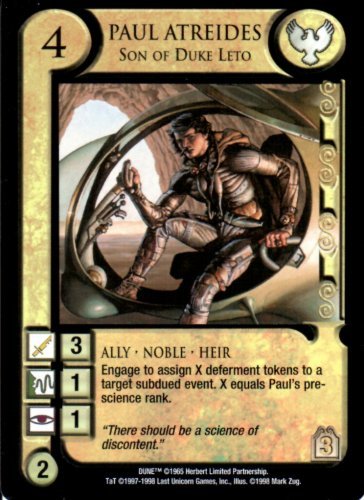
While researching the Dune 4x game concept, I came across information about a discontinued Dune card game. I dug deeper, remembering an advertisement in the InQuest magazine I used to read. It featured Paul Atreides, in an ornithopter cockpit:
On the surface, the game appeared to be a clone the popular card game Magic: The Gathering, which had popularized the selling of randomized packs of cards to be used on a competitive game. But the details distinguished Dune from it's antecedent.
The rules of Dune are much more specific and layered than in Magic - as an example, each card tells you the exact phase and conditions where you can play it, even down to the step of the turn and how long the card's effect will last. 
The game is built to support more than 2 players, and has a two-tiered win condition of gathering enough spice and enough political favor - conquest and destruction are a means to an end, but not an end of themselves.

This started me on a journey of discovery and seeded the idea of converting old, out of print Customisable Card Games (CCG) into single box, complete card games. 

Buried Games:
Dune CCG
Aliens Predator CCG
Terminator CCG
Star Trek 1st / 2nd Edition CCG

Monday, March 13, 2017

Tabletop Spaceship Wargame Design Part 10, Researching Firestorm Armada v2

Firestorm Armada is a fleet system that is as complex as Battlefleet Gothic but using different mechanics to accomplish dynamics.

Weapons roll pools of six sided dice to determine how effective the shots are at damaging the target.

Weapons have a profile that describes how many dice they roll at each range. These dice are rolled and compared to
Dice that turn up as a 6 'explode' and add another die to the pool.  Instead of each success dealing a point of damage, the total number of successes are compared to the target's armor. If successes >= Armor, the ship takes a hit.

After testing out the game I found the exploding dice to be untenable. It resulted in lots of unfun situations, either impossible comebacks or annihilating any chance of a comeback.
The armor system also generates situations where a ship's turn results in nothing if they don't score enough hits. For me that doesn't fly. My target is a few ships, so each activation should be impactful. With the armor system, perfect tactics can be denied an effect due heavily to dice rolls.

Tuesday, February 23, 2016

Tabletop Spaceship Wargame Part 8, Meta systems!

Previously I established the core tenets of the movement system. I'm attacking broader questions at this point and I need to take a stance on several issues I've encountered across different games.

Scale-ability
Some games work really well on a small scale, and then fall completely apart at a larger scale. This cannot be completely mitigated. The impact of scale on the game can be reduced through the use of mechanics that are less intensive at larger scales.

For example, if players set each piece's movement pattern simultaneously then there is less down time as players are resolving a step of the game at the same time rather than taking turns. This mechanic would also keep team games quick.

A less optimal but simpler mechanic would be for players to alternate moving pieces. This allows players to react to each other's moves as the turn progresses and makes the choice of which pieces to move important for obtaining an advantage. This breaks down in games with more than 4 players as the time between moves becomes substantial.

The method I'm least fond of is on your turn, you move every unit you control. This is boring for the opposing player because it is a passive experience - they cannot act with the current information until the entirety of their opponent's forces have moved.

For now movement will alternate as each player selects a piece, completes it's movement, and then the other player follows suit.

========================================================================

Another piece of this puzzle is whether or not a unit destroyed before it's turn gets to fire. There are games that allow this, and there are games that do not. The difference is in the amount of punishment the target player should receive. Given that whether a piece can be attacked or not is under some control of the player, a destroyed ship is at least partially a result of their choices. This also alters how less durable ships affect the game. If they can fire the turn they are destroyed then 'glass cannon' ships would be more viable and powerful. If not they represent a higher risk.

In order to keep the game accessible, the rules allow a ship to fire on the turn it is destroyed. This helps negate the disadvantage of first turn in a manner compatible with the abstraction present in other areas of the game.

========================================================================

Initiative
Moving first in this game is a disadvantage. Going second lets you react to the other player's moves, and you have the distance advantage when measuring range to fire weapons. Due to the nature of the game alternating turns are the only practical method to resolve game mechanics in an orderly fashion.

Initiative will be determined by a coin toss for now. As the game develops it may be useful to have slower reacting factions have a penalty to Initiative.

The player that wins Initiative deploys his ship, moves, and fires after the player that lost initiative.

Monday, February 22, 2016

Tabletop Spaceship Wargame Part 7, Adding movement!

So this is where we left off with rules.

Turns:
  • Players alternate turns. 
  • A player can [only] act on their turn.
  • On their turn, a player [Moves] and then [Attacks] 
  • Flip a coin. The winner of the toss gets the first turn.
Movement:
  • Your ship can move [anywhere] on the play space.
  • The play space is [infinite] size.
  • Your ship may move at [any] time
Attacking
  • Your ship can shoot [Once] per Turn
  • Your ship deals [1] damage per shot
  • Your ship hits [on a D6 roll of 4, 5, or 6]
  • Your ship damages targets [automatically]
  • Your ship can take [1] damage before being destroyed
The game is starting to take shape but there aren't enough systems in the game to create meaningful choice. Because all of the movement variables are equal and infinite, there is no difference between them - they do not impact play at all. 

So this post will be about bringing in a basic movement system, what choices will be made to construct that system, and what each decision means for the other systems in the game.

In a previous post, I laid out the advantages and disadvantages of a freeform movement system versus a grid based movement system. I've judged that a grid movement system better suits the accessibility goal of the game.

So what is a movement system? Let's take a look at a couple of different games that involve movement and see what elements they share.

The examples of movement that I will use are Quake 3 Arena, Chess, and Warhammer: 40,000. Each of these games are very different but have the same goal of competition against another opponent.

In Quake 3 a single character is controlled by the player and can move in two dimensions to a great extent by 'running' and vertically to a limited extent by 'jumping'. The 'level' or environment may provide additional movement options keyed to a discrete location.
The goal of the Deathmatch game mode is to be the first to a set number of 'frags' - achieved by killing other player characters. This is accomplished by using a variety of weapons with different statistics - damage, arc, time to target, area of effect, ammunition supply - to harm other players by hitting them with projectiles. Hitting with these projectiles is hampered by both the attacker and the target's movement and relative position. 
A slow projectile fired at long range will take more time to reach the target, giving it more time to avoid the attack. A pinpoint attack with slow fire rate will be difficult to use if the target is close. Having a discrete movement system allows the weapon interactions to have more options and choices. These choices expand further with the restrictions that terrain provides.  

Chess has a set of pieces controlled by each player and the objective is to trap the enemy's King piece. Each type piece has a set of rules that governs their movement - knights, pawns, rooks, bishops, queen, king. 
Unlike Quake, all pieces attack in the same manner - they must have a valid target based on their movement rules, and when they move onto a space occupied by an enemy piece according to those rules, they capture the other piece. This highlights how player options are provided by each piece with it's movement. The ideal move captures an enemy piece and prevents the enemy from capturing your piece. 

In Warhammer 40,000 each player controls a set of pieces that represent different infantry, vehicles, and artillery units. Each of these units has different attacks, defenses, and movement types. The goal is to either capture ground or destroy the opposing army.
Different units move at different rates and interact with difficult terrain in their own way. Infantry can be slowed, vehicles may be immobilized or destroyed, flying units ignore it unless they stop inside the terrain in which case they may suffer casualties. Since Line of Sight and weapon range are vital to attacking targets, moving relative to other units and terrain becomes the core of the game. All weapon and unit functions are built out of how a unit can bring that weapon to bear.

The common elements in these games is that movement is fundamentally tied into achieving goals. In quake, movement helps protect characters as well as provide avenues to attack. In Chess, positioning is how you attack and how you protect your pieces. In Warhammer 40,000 movement is used to protect your forces, achieve mission goals, and to attack the enemy.

========================================================================

The Movement system needs to provide a way to bring attacks to bear, and to avoid enemy attacks. This means that weapons need to have limitations to make movement meaningful. I'm following the majority of games in the field by including range, line of sight, and firing arcs as rules for attacks.

Movement can now make a difference when weapons have a limited range and field of fire. Now for the basic rules of moving ships around on a map grid. I've decided the grid type will be hexagons.

Turns:
  • Players alternate turns.
  • A player can [only] act on their turn.
  • On their turn, a player [Moves] and then [Attacks] 
  • Flip a coin. The winner of the toss places their ship anywhere within [3] Hexes of their board edge. Then the other player places their ship.
  • Ships take up 1 Hex and must face one of the edges of the Hex.
  • The player that deployed second gets the first Turn.
Movement:
  • The play space is [20 x 40 hexes] in size.
  • Your ship may move at [the start of your turn]
  • Your ship may rotate once, turning to face a Hex edge adjacent to it's current facing
  • It may move 4 hexes towards the edge it's facing.
Attacking
  • Your ship can shoot [Once] per Turn [After you finish movement]
  • Your ship can shoot [At targets within it's forward 60* arc] that are within [10] Hexes
  • Your ship deals [1] damage per shot
  • Your ship hits [on a D6 roll of 4, 5, or 6]
  • Your ship damages targets [automatically]
  • Your ship can take [1] damage before being destroyed

Hmm. Lots of refinement left. But baby steps!

Monday, February 15, 2016

Tabletop Spaceship Game Part 5, Iterations!

Now that a ship's displacement of theory has been spun, let's get to the base model of the game. In order to test systems in a productive manner, I need a functional core set of mechanics. I've seen that starting with anything more than a base set of mechanics causes confusion and misleads priorities.

With that in mind, and what we've covered before, what does a wargame need?
1. Victory Conditions
2. Movement
3. Attacking

Solid. Let's expand these, to minimum functionality. Each of these iterations is going to be painfully basic, but this process is important to actually 'figure' the game out.

0.01:
Victory Conditions:

  • you win when the other player's ship is destroyed.

Movement:

  • Your ship can move anywhere on the play space.
  • The play space is infinite size.
  • Your ship may move at any time
Shooting


  • Your ship can shoot any number of times
  • Your ship deals 1 damage per shot
  • Your ship hits automatically
  • Your ship damages targets automatically
  • Your ship can take 1 hit before being destroyed
This version is unplayable. Why it's unplayable is important for putting barriers in place. This ruleset results in both players ships exploding instantly since ships can shoot infinite times at any point in the game, automatically hits, and automatically damages the target. There is no meaningful choice, and no reasonable way for the game to provide satisfactory play.

The first step I'm taking is to introduce a 'turn' mechanic. 
------------------------------------------


Turns:
  • Players alternate turns. 
  • A player can [only] act on their turn. 
  • Flip a coin. The winner of the toss gets the first turn.

Good. Where earlier both sides would blast each other simultaneously, Turns ensure that only one player will be able to act at a time. But there is still the problem of movement and Attacking happening at any time in the turn - let's regiment that a bit. Also Attacking should happen only once per turn. And let's restrict it to a single target while we are at it. Let's see what we've got here:

[brackets] fence in variables that may change later. This helps keep eyes on the prize
Capital letters highlight important game concepts, such as Victory Conditions.

Each player controls [1] Ship

Turns:
  • Players alternate turns. 
  • A player can [only] act on their turn.
  • On their turn, a player [Moves] and then [Attacks] 
  • Flip a coin. The winner of the toss gets the first turn.
Movement:

  • Your ship can move [anywhere] on the play space.
  • The play space is [infinite] size.
  • Your ship may move at [any] time
Attacking


  • Your ship can shoot [Once] per Turn
  • Your ship deals [1] damage per shot
  • Your ship hits [automatically]
  • Your ship damages targets [automatically]
  • Your ship can take [1] damage before being destroyed
This is better. But still inadequate. The first player will win every match guaranteed. The restrictions added previously help lay the foundation for future rule systems required to make this game more interesting.

So what's next. The current problem is that the first player wins, guaranteed. This is not fun, it's not a game at this point. So there needs to be some additional factors to add complexity, depth, and choice to this prototype.

The most direct way to make sure the first player doesn't always win is to introduce chance. 

Attacking
  • Your ship can shoot [Once] per Turn
  • Your ship deals [1] damage per shot
  • Your ship hits [on a D6 roll of 4, 5, or 6]
  • Your ship damages targets [automatically]
  • Your ship can take [1] damage before being destroyed
Ok. With this setup, any player has a 50% chance of missing. This allows the second player to win, while also allowing the possibility for the first player to win. However, this introduces a new problem specific to this mechanic: The game could last infinite turns if players keep rolling below 4 on their Attack Die.
Time to solve that with a turn limit! Each player gets 6 turns. If a ship isn't destroyed by Round 6, the game is a Draw.

Alright. This is quite crude,  but it's a start. Further posts will detail further revisions and development.

Wednesday, February 10, 2016

Tabletop Spaceship Game Part 3, Foundation

The Atomic approach
Utilizing a reductive method to start from the smallest elements of a game, and after identifying and understanding each, combining them into stable molecules and compounds to support the original intent.


This lecture series on Youtube proved a good place to start for me to understand wargames from a longer and wider perspective than my own. I'm incorporating pieces of these lectures in addition to Mark LeBlanc's work to create a solid foundation that I can reference when creating mechanics further in the design process.

I will utilize material covered in this video:

Introduction, Features of All Games


Representation
What you see in front of you when you look at the game.
The game is represented by the various miniatures or tokens arrayed on a [gridded/open ] play map with reference cards for each faction set to the side. Several colors of dice will be available and a track marking victory progress for each player. Templates and measuring aids will be available as well, with a rules reference sheet and full rulebook out of the play area.


Mechanics
Mechanics are things you assemble to get a game - mechanisms that execute to make the game function.
Mechanisms slated in the game at this point are to remain mostly undefined to fit my atomic approach.

Confirmed mechanics:
Player Turns
Dice Rolling
Modular Board
Variable Player Powers
Capture / Eliminate
Movement
Resource Management
Risk & Reward
Game Modes
Piece Elimination
Victory Points
Loss Avoidance

Possible mechanics:
Reference Cards
Force Construction
Factions|Open Purchase
Catch Up
Secret Unit Deployment
Time Track
Action Point system (Star Fleet Battles, Federation Commander)
Rock Paper Scissors
2+ players
Team play
Player Elimination
Cooperative Scenarios
Wagering resources / Press your Luck
Campaign Play
Route Building
Card Driven Battle / Campaign
Deck / Pool Building
Point to Point movement
Simultaneous Action Selection
Action Programming / Pencil and Paper, recording orders
Variable Unit Command / 'Chit-pull system'
Grid Movement
Memory
Area Control / Influence
Pick up and Deliver

Style
emphasis of a specific mechanic, what mechanic the game relies on.
This will have to be rather light at this point, because so little of the game is established picking mechanics to emphasize is premature.

Theme
What is the game about
The game is about fleets of spaceships fighting.

Components
What falls out of the box when overturned
Play Surface
Dice
Tokens
Chit Counters
Reference Cards, Sheets, Rules
Rulebook
Miniatures
Templates
Ruler
Terrain tiles

'Shape'
Term from Japanese game Go, Thin and elegant or Thick and clumsy
How much space the game uses in a player's life
The target for this game is to have a very thin presence for play and setup, and ideally a thick space in overall time playing.

Voice
I / We / First Person
You / You / Second Person
*He/She / They / 3rd Person*
The player's actions reflect the decisions and participation of hundreds or even thousands of imaginary officers and crew.

Content
Subject of the game
What are the resources?
This overlaps quite a bit with Theme, and so far isn't well defined with the current rules (or lack thereof) at this time. Content is what distinguishes this game from others like it.

As the game goes through iterative design, I'm going to revisit these elements and fill them in.

Tabletop Starship Game Part 2, Approach

I began designing this game by attaching systems and components from other games that I liked. While trying to break those compound mechanics into molecules small enough to balance, a friend told me to start from the absolute basics and work my way up. He was right, and I had given that same advice to another friend who was forging his own system.

I found that assembling the game without starting at the foundation left a lot of assumptions unquestioned. It was difficult to understand the components I liked, because they were not designed to be used in a modular way. Even if I was successful in patching these pieces together, it would be a nightmare to interpret balance across the sum of six or seven games.

By starting at the marrow of the game and building outwards, the systems will be consistent and work together far better.

I call breaking things down to this elemental level the 'atomic' approach.

New project! Tabletop Starship Wargame, Part 1

Hey there. After playing Star Wars Armada and X Wing miniatures, it stoked the fire of an old desire to create my own table top wargame system with spaceships.


Each game I've played in that genre has left me with some issue or another, and I've experienced enough different systems that I've got a good idea of what I want in and what I want left out.


I'll start with the elements from the games I have experienced that ended up being sticking points that have lead to me creating my own system.


I have played Call to Arms: Babylon 5, Call to Arms: Star Fleet, Battlefleet Gothic, Star Wars: Armada, Star Wars: X Wing, and am familiar with Halo: Fleet Battles, Firestorm: Armada, Federation Commander and Star Fleet Battles.


The goals for this game system are as follows:
1. It should play fast.
2. It is Capital Ship Fleet scale
3. Fighter Craft play a role


Ideally, here are some additional preferences:
A. Construction rules will be provided so players can create profiles for their own imagined ships
B. The ruleset should be flexible enough to represent a wide variety of ships.
C. The game should scale up in a reasonable fashion.

With these thoughts in mind, we begin.