It didn't go well.
I had a really tough time teaching my playtester how to play the game. We ran into language issues, unclear rules, complex steps, and unintuitive mechanics.
We didn't even finish the match. We got an hour in and I had lost patience.
I was so discouraged after the playtest that I shelved the project for a while. I felt that the project was so large already, I had spent so many hours transcribing the cards and researching, and now the rules proved to be a foundation of sand.
In my distress the project felt impossible.
------
Fast forward a few weeks, and I chat with a friend about my issues. I start translating the rule mechanics from their unclear thematic language to more common terms.
That's where I had my breakthrough: The rules weren't air-tight or clear. One term (Deploy) refers to two completely different operations (Playing a card from your hand, and turning a card from face-down to face-up). The rules for tactics cards aren't clear on what order to resolve them in. Etc.
That gave me a way to continue the project - I was having trouble teaching the rules because the rules are unclear, and don't make sense, and are incomplete.
If I fix the rules, and fill in the gaps, I should be able to teach the game more easily and get to grips with the gameplay faster.
I'm now taking the rules apart at the atomic level, and using Magic: The Gathering Rules to fill in the gaps and extrapolate solutions from 30 years of their rulebook development.
Monday, June 1, 2020

Wednesday, March 18, 2020
Aliens Predator CCG: Card Design Part 1
Aliens Predator Card Designs
A problem with all the cards is the font used in the name. It has readability issues and could be improved. Second, the Resources and Restrictions listed along the left side of the cards are printed vertically. That's hard to read without turning the cards or craning your head, and this text is often required to tell if you can play a card or not.


Locations form the 'map' where the game takes place. Characters move between adjacent locations, and can search them for equipment and supporting characters. I like the graphic card frame and the prominence of the image.


Main Characters are under the direct control of the players. They move, attack, and search for supporting characters and items. These frames look interesting, but the flavor text overlaps some of the graphic elements making it harder to read.

Supporting Characters are found by main characters and are used by the different factions to win the game. The contrast on the card is nice - they look really plain, and wildly different than the other character cards for easy distinction.

Events are played for temporary buffs or penalties. I like the design but the texture under the effect text makes it harder to read than necessary.


Items are used by the Humans and the Predators. The Human Item frame is very solid. I like the graphics and the texture doesn't interfere with the Effect Text and the Flavor Text. The Predator frame has wasted Effect Text space, and the texture underlays the Name and Flavor Text entirely.
These cards were redesigned with the release of the Resurrection expansion, and to match the Terminator CCG which used the same rule system.
Tuesday, March 17, 2020
Dune CCG: New Card Faces

The Dune cards hold a ton of information - There are symbols, number attributes, type and timing information, all kinds of stuff. There are about 17 variables contained in each card which makes them tough to design, all that information needs to be organized in a readable and clear manner.
My goal when making these templates was to prioritize learning the game above all else - with complex rules and detailed cards, making the information clear to new players is vital to keep them playing.
The first step was to simply remove the image field. I don't have the resources to create art at this point, so diverting that space to rules text was a given. From there I identified each part of the card that had information important to the player and to give each piece a place on the card.
As an example, some effects refer to one of the five broad card types: Holdings, Plans, Resources, and, Personas, and Events. But the cards in the original game don't list that information - they use a different card frame to indicate card type. I don't think that's enough of an indicator, so I made the card type explicit under the card's Name.
I also added labels for Allegiance, Talent Requirements, Cost, Command and Resources to make those markers more clear. In the base game they are

Personas are the main 'actors' in a game of Dune. They can make battle, begin intrigues, duel other personas, and arbitrate over contracts. They can be improved with Resources like liaisons, vehicles, and weapons.

Plans are temporary special powers that you can play to alter the game. Each Plan's subtype shows where, under which conditions, and what phase it can be played during.

Resources are attached to Personas and Holdings to amplify their abilities. A card's Command is the limit of Resource cards that can be assigned to them.

Holdings are the other key card in Dune. They represent locations or large scale government operations. They often generate resources, and can be upgraded with Resource cards.

After playing through with a set of these cards, I'm considering how to make room for the art with a redesign. The first alternative I'm thinking is to replace the 'skill box' with Magic: The Gathering Keyword-style text, like Battle 3. Other alternatives include breaking the skill box into 3 separate modules, or to have a full stat line like Warlord CCG.
Friday, March 6, 2020
Aliens Predator CCG 1: A peculiar gem
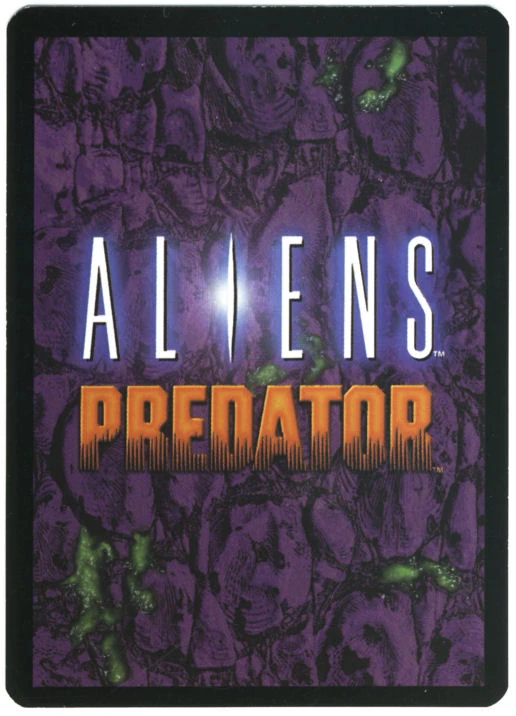 |
| An Aliens Predator card back, with the name of the game over a dark purple background. |
I first found this game as a child in my local card game store - Dave's Doug Out, on San Pablo Avenue. It was bigger and brighter than the other card store, Cosmic Cards and Comics on Solano, so I spent more time at Dave's.
It was 1997 and I saw a display that said Aliens Predator on it. At this point I hadn't seen any of the movies, but delighted on stories from friends who had, and the wildly unrestrained Kenner line of toys.
My first experience with either franchise were the toys, which came with mini comics. They were colorful and action packed, so I loved them and had no context to put them in. That laid the foundation for my love of both series - an unrestrained universe full of color, creativity, dynamism, and pulp styling.
So I bought two starter decks on name recognition alone. I got the Marine and Alien starter set, because I heard a lot more about Aliens than Predator. This was at a time where I would buy starter decks and not actually learn the game - usually because no one else would pick up the game, and I didn't understand the rules enough to teach it to my friends. Other games that followed this example: Star Wars, Babylon 5, and Pokemon.
I got super excited about Aliens Predator because it had pictures that looked exciting and a tense atmosphere - Aliens were out there! They were gonna get ya!
But the rules were very complicated for my kiddo self. I remember gushing about the game to a friend, and they asked how to win, and I *had no idea* because that was at the end of the rulebook in a tiny chapter that says to refer to the scenario being played for victory conditions. I didn't even know there were scenarios!
The game is wildly different from the other CCGs I've experienced because it operates much more like a tactical board game than like Magic: The Gathering or Yu Gi Oh!. Players lay out Location cards and move characters between them, searching for equipment or weapons or victims. Lots of the cards have specific context requirements to play rather than a cost system or limited plays like other games. And most different, the game does not work without a Scenario governing the rules of the game.
All of these combined to make the game difficult to learn, and more difficult to teach. I ended up not playing the game until 20 years later when this revival project started with Dune. I got three starter decks off of Ebay, and I still have my rulebook from 1997. I've played two matches so far using the 'Contact' scenario, and the problems we ran into indicate that this one is going to take a lot more work than Dune will to get table-ready.
I'm excited :)
Wednesday, March 4, 2020
CCG Regeneration: Card Back Designs
I've finished transcribing all the Dune CCG cards and developed templates for new printings:
I wanted the card backs to be very distinct in color, but have a matching design to reinforce the relationship between the House Deck, which represent an individual House's resources, and the Imperial Deck, which represents unique assistance from other forces within the galaxy at large.
I used purple for the Imperial background color to reference the Imperial Deck's higher status, and I used blue to indicate that the House Deck is still of 'nobility' but to a lesser degree.
Both card backs use patterns to add texture to the background color. I chose different patterns to further subtly differentiate the cards from each other.
Both cards use a
"Purple was the color worn by Roman magistrates; it became the imperial color worn by the rulers of the Byzantine Empire and the Holy Roman Empire, and later by Roman Catholic bishops. Similarly in Japan, the color is traditionally associated with the emperor and aristocracy.[7]" - Wikipedia
"Blue has been an important colour in art and decoration since ancient times. The semi-precious stone lapis lazuli was used in ancient Egypt for jewellery and ornament and later, in the Renaissance, to make the pigment ultramarine, the most expensive of all pigments. In the eighth century Chinese artists used cobalt blue to colour fine blue and white porcelain. In the Middle Ages, European artists used it in the windows of cathedrals. Europeans wore clothing coloured with the vegetable dye woad until it was replaced by the finer indigo from America. In the 19th century, synthetic blue dyes and pigments gradually replaced mineral pigments and synthetic dyes. Dark blue became a common colour for military uniforms and later, in the late 20th century, for business suits. Because blue has commonly been associated with harmony, it was chosen as the colour of the flags of the United Nations and the European Union.[2]" - Wikipedia
 |
| Image of a card with a blue background, a light blue geometric pattern, with a gold geometric pattern in the foreground. The card is labelled 'House'. |
 |
| Image of a card with a purple background, a light blue geometric pattern, with a gold geometric pattern in the foreground. The card is labelled 'imperial'. |
I used purple for the Imperial background color to reference the Imperial Deck's higher status, and I used blue to indicate that the House Deck is still of 'nobility' but to a lesser degree.
Both card backs use patterns to add texture to the background color. I chose different patterns to further subtly differentiate the cards from each other.
Both cards use a
"Purple was the color worn by Roman magistrates; it became the imperial color worn by the rulers of the Byzantine Empire and the Holy Roman Empire, and later by Roman Catholic bishops. Similarly in Japan, the color is traditionally associated with the emperor and aristocracy.[7]" - Wikipedia
"Blue has been an important colour in art and decoration since ancient times. The semi-precious stone lapis lazuli was used in ancient Egypt for jewellery and ornament and later, in the Renaissance, to make the pigment ultramarine, the most expensive of all pigments. In the eighth century Chinese artists used cobalt blue to colour fine blue and white porcelain. In the Middle Ages, European artists used it in the windows of cathedrals. Europeans wore clothing coloured with the vegetable dye woad until it was replaced by the finer indigo from America. In the 19th century, synthetic blue dyes and pigments gradually replaced mineral pigments and synthetic dyes. Dark blue became a common colour for military uniforms and later, in the late 20th century, for business suits. Because blue has commonly been associated with harmony, it was chosen as the colour of the flags of the United Nations and the European Union.[2]" - Wikipedia
Tuesday, March 3, 2020
CCG Regeneration 2: Road Map
These are the steps I will follow when investigating old Customizable Card Games for conversion into boxed card games.
Acquire the Game
First step first. Acquiring the game includes finding potential abandoned candidates, collecting rules errata, and obtaining what card information is available in case additional sets are required. Then I order some starter decks or find a Tabletop Simulator module so I can try the game.
Learn the Rules
I read through the rules a couple of times to familiarize myself with the new game. Lots of these games were abandoned because of how complex they are relative to Magic: The Gathering, so I need to be diligent to make sure I understand how it works before bringing it to the table.
Play the Game
I get out the cards and play a few dummy rounds against myself. Even though I have perfect information, this is a very important step in figuring out how the game flows at the table. Any places I run into friction indicate a place in the rules I need to clarify.
This preparation helps me
Record the Cards
I use online scans (or a rare physical collection) to fill a spreadsheet with the card information. Ideally I can get a complete record. Lots of time is spent researching in this stage. I make small changes like incorporating errata and rulings on early cards to reduce the later workload.
Determine if the Game is suitable for conversion
With playtesting, I hope to find if the core game functions without the collectible aspect. I'll work to adapt the game if it is still fun without the excitement and risk of buying randomized packs, the engagement of active support and competitive scene, and the prospect of new sets being released regularly.
Change Rules
With an understanding of the game I can change the rules and cards to better fit the single-box model. Trash tier cards with low utility are re-worked or eliminated, deck construction rules are streamlined, and different formats like Draft and Constructed are formalized. The conversion's structure will take form here - how many different sets of cards, whether expansions in the original game will have to be separated from the 1st edition cards, and so on.
Play Game with new Rules
New rules, new playtests! This step will take the longest. The synergies and interactions in CCGs are very complex and most can't be anticipated outside of playtesting.
Repeat until satisfied, or the game is deemed unsuitable.
And then we're done!
First step first. Acquiring the game includes finding potential abandoned candidates, collecting rules errata, and obtaining what card information is available in case additional sets are required. Then I order some starter decks or find a Tabletop Simulator module so I can try the game.
Learn the Rules
I read through the rules a couple of times to familiarize myself with the new game. Lots of these games were abandoned because of how complex they are relative to Magic: The Gathering, so I need to be diligent to make sure I understand how it works before bringing it to the table.
Play the Game
I get out the cards and play a few dummy rounds against myself. Even though I have perfect information, this is a very important step in figuring out how the game flows at the table. Any places I run into friction indicate a place in the rules I need to clarify.
This preparation helps me
Record the Cards
I use online scans (or a rare physical collection) to fill a spreadsheet with the card information. Ideally I can get a complete record. Lots of time is spent researching in this stage. I make small changes like incorporating errata and rulings on early cards to reduce the later workload.
Determine if the Game is suitable for conversion
With playtesting, I hope to find if the core game functions without the collectible aspect. I'll work to adapt the game if it is still fun without the excitement and risk of buying randomized packs, the engagement of active support and competitive scene, and the prospect of new sets being released regularly.
Change Rules
With an understanding of the game I can change the rules and cards to better fit the single-box model. Trash tier cards with low utility are re-worked or eliminated, deck construction rules are streamlined, and different formats like Draft and Constructed are formalized. The conversion's structure will take form here - how many different sets of cards, whether expansions in the original game will have to be separated from the 1st edition cards, and so on.
Play Game with new Rules
New rules, new playtests! This step will take the longest. The synergies and interactions in CCGs are very complex and most can't be anticipated outside of playtesting.
Repeat until satisfied, or the game is deemed unsuitable.
And then we're done!
Subscribe to:
Comments (Atom)